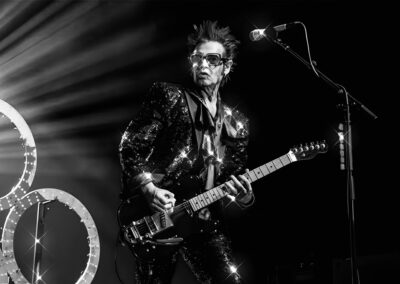

I’ve lived through those extremes, times when everything looked perfect from the outside. The career was strong, the band was doing well, everyone thought I had it all together… but privately, I was falling apart. –– Daniel Ash
Daniel Ash’s career has always been defined by motion — forward, sideways, anywhere but still. Now, with Ashes & Diamonds, his new band alongside Paul Denman and Bruce Smith, Daniel Ash sounds newly ignited. “It’s like being nineteen again” — he says. and that spark is unmistakable.
Our first conversation in the summer of 2025 was an introspective portrait of a restless artist still driven by passion and curiosity. Not long after, Daniel sent over the finished Ashes and Diamonds album — Are Forever, seven years in the making, recorded twice, and ultimately reborn through instinct, experience and experimentation. The result feels textured, cinematic, mischievous and organic — a record that shifts between humor, darkness and warmth like a conversation in motion. So good, in fact that we wanted to reconnect and dive deeper.
In this follow-up interview, Daniel Ash opens up about the story behind the album, his rekindled love for guitar, second chances, the courage to start over, artistic chemistry and the strange beauty of collaboration in the digital age. Funnier, freer, and still unmistakably himself. Here’s Daniel Ash, unfiltered, on Are Forever.
––Hi Daniel, how have things been going on your side?
Daniel Ash: Hi Mandah! Things have been good. I’ve actually been buried in edits all day for the new Boy or Girl video. There’s this talented woman in the UK working on it — her name’s Vivienne Cure. She’s really artistic, very sharp visually. We decided to give her the song without any specific direction because we didn’t want to get tangled in the whole gay–straight–political debate around the theme. We just wanted someone with a fresh, intuitive take on it. And she absolutely delivered. I was speaking to her again this morning about the final tweaks — we’re nearly there now, just polishing details. You should look her up; she’s got fascinating work. She’s based in London and very creative and connected. I’ll send the music video to you when it’s ready. Anyway, how have you been?
––Good, thanks. I’m looking forward to the video!
Let’s talk about this particular song a bit later, shall we?
Daniel Ash: Sure, absolutely!
––I really enjoyed our conversation back in summer, and I thought it would be great to reconnect for the release of Ashes and Diamonds’ debut album Are Forever. I absolutely loved the record, and I’ve seen that some early reviews are finally coming out — all of them are really positive! How does it feel?
Daniel Ash: Thank you! It feels absolutely fantastic, to be honest. The feedback so far has been incredible. We’ve had an 8 out of 10, a 9.5 out of 10 and even a full 5 out of 5. That’s everything you could hope for as a band, really. After all the years of work and those long back-and-forths, to see people respond like that, it’s such a nice feeling. You know, when I sent you the record over the summer, I was really curious about your take, because I value honest reactions. And to see it land well with people everywhere… it’s genuinely exciting. With this band, everything feels new again. I haven’t been this fired up in years — it’s like being nineteen again. Those seven years of trial and error finally paid off, and now it feels like the start of something fresh. If you do end up writing that full review, I’d love to read it. That’s the kind of feedback that keeps the spark going.
––I’ll do my best to have a full review ready before the release. But before that, let’s get into the heart of it, the story behind the album. When you, Bruce, and Paul first started working together, what made you realize this wasn’t just a one-off project, but a real band?
Daniel Ash: I wouldn’t have gotten involved otherwise. Paul contacted me about seven years ago. We’d talked before, but the timing wasn’t right at the time. I actually knew his wife, Kim, from art school. She was in the fashion course, so there was already a little reconnection there. It was Kim who suggested Bruce as the drummer. At that point, I hadn’t met Bruce at all. He lives near New York, but he flew over to Los Angeles, and we met. We literally first met in the car park (laughs). We said greeted each other, carried our gear into this tiny rehearsal room, set up, and within half an hour we were making noise. I think we came up with a song that very first day. It just clicked instantly.
––That’s incredible, almost like the chemistry was already waiting for you to meet.
Daniel: Exactly. That’s the thing, when it’s right, it’s immediate. There was no hesitation, no awkward warm-up period. Just instant spark, instant music.
––You each have such iconic musical DNA. What did working with Bruce and Paul bring out in you that might not have surfaced if you’d worked alone?
Daniel Ash: Arrangements, without a doubt. The way we worked was quite fluid and natural. Bruce and Paul would usually send me a rhythm section first, just a beat and a bass line, and I’d build from there: melody, lyrics, guitars, the whole top layer. Then I’d send it back, and that’s when Bruce would often come in and completely reimagine the structure, shifting where the verses fell, trimming down a chorus, or sometimes doubling one to change the flow. At first, I’d protest, “No, no, no, this isn’t right” — but then I’d sleep on it, come back the next day, and realize, actually, he was right. It worked better. It’s humbling, in the best way, a lesson in keeping your ego in check and trusting other people’s instincts. When you work alone, you only answer to yourself, and that can make you narrow without realizing it. But when you’re working with musicians at this level, you learn to stay open. That’s when the real magic happens. What I love about this band is that there’s no hierarchy, no one steering the ship. Every song has to feel right to all three of us, or it doesn’t make the cut. That equality is what gives the record its strength, I believe. There’s no pecking order, just three people creating something we all believe in.
––That’s a good dynamic. So, what are their individual superpowers?
Daniel Ash: Like I said, Bruce has an incredible instinct for arrangements. He can feel when a song’s structure needs tightening or when space will make it breathe. And Paul just got those great bass lines. If the drums and bass aren’t speaking to me, I don’t carry on with the track. That’s the foundation; without that pulse, I can’t build anything on top.
––You told me before that you recorded the album twice. What changed the second time?
Daniel Ash: The first version just didn’t feel alive. We’d done it all remotely — sending files back and forth from different parts of the world. Although it sounded fine technically, it didn’t have a soul. Something vital was missing. So, we made a pretty risky and expensive decision: scrap the whole thing and start over. We booked a studio in Hollywood, Bruce flew in from the East Coast, and we gave ourselves ten days to re-record everything. It was an expensive mistake but also, a blessing in disguise. By that point, we’d lived with these songs for about six years, so everyone knew them inside out. That made the sessions all about capturing the best performance, the real energy of the band playing together. And there was another twist, during rehearsals, I stumbled upon this Fender Hot Rod amp sitting in the corner of the studio. I plugged in, and the sound blew me away. I ended up buying one and using it for the re-record. It completely reignited my love for guitars (laughs). I’d actually been a bit bored with them before. That amp inspired me to play again, and that spark became a big part of why the new recordings finally felt right. The rerecorded version of the album has a lot more guitars in it.
––Oh! Sometimes time really does align things better than we could have planned. The album does feel organic and alive and that’s what I like about it. I guess it’s important that musicians are in the same room, catching each other’s energy.
Daniel Ash: Exactly, yeah! No doubt. When you’re all in the same space, there’s this invisible current running between you. You can’t fake that with files or plugins. It’s energy, body language, timing — the little accidents that make something human. That’s what I missed on the first version. It sounded good, but it was missing the glue, the soul. Once we were in the studio together, the songs suddenly had life, a soul. They started to breathe. That’s why it feels organic; it’s not just about the sound, it’s about people reacting to each other in real time.

––The record moves through post-punk, electronic, and experimental pop textures, yet it still feels completely cohesive. Why do you think that is?
Daniel Ash: Exactly because of what I just said. The reason it feels cohesive is because we were playing together in the same room. That’s the secret. It’s not just a bunch of files flying back and forth across the world. It’s three people reacting to each other in real time. When you’re actually there, feeling the air move, catching someone’s glance before the chorus drops, it changes everything. It becomes a living, breathing thing. That’s what makes it human, and that’s why it holds together no matter how many different styles we touch. That pulse is the band. You can’t program it; you can only get it when it’s happening.
––It makes sense.
What’s your best memory from the recording sessions?
Daniel Ash: The recording itself. The location of the recording. The studio we rent was Johnny Depp’s studio in Hollywood. It doesn’t feel like a studio at all. It feels more like someone’s living room. There are big red curtains, guitars and photos everywhere, soft lighting. It has this warmth that immediately puts you at ease. Nothing sterile or intimidating about it. And working with Robert Stevenson, who’s Johnny’s right-hand man, made a huge difference. He co-mixed and co-produced the record. He’s got such a great ear. He really helped us shape the sound and keep the creative energy flowing. Oh, and one more thing, in that studio, you’re actually allowed to smoke cigars (laughs). Most studios forbid it because it supposedly damages the equipment, but Johnny Depp doesn’t care at all. That kind of freedom changes the atmosphere completely. Everyone relaxed, no pressure — just music.
––It sounds like a really warm atmosphere, not one of those sterile, neon-lit studios where everything feels detached. Which song turned out to be the most challenging to create or complete?
Daniel Ash: Honestly? None of them. The moment a song starts to feel like hard work, it usually means it’s not meant to be. The best ones arrive when you get out of your own way — when you stop thinking and let the heart, or maybe instinct, take over. That’s been true throughout my career. Bela Lugosi’s Dead, early Love and Rockets tracks, Tones on Tail — all those pieces came together quickly, almost as if they wrote themselves. There’s a certain kind of magic that happens when everything aligns, the sound, the mood, the people in the room. You can’t plan it and you definitely can’t force it. You just have to recognize it and catch it while it’s happening. I think we talked about that back in summer, didn’t we?
––Yes, we did. We also talked about the cut-up method you use for writing. Do most of the stories on this album come from that process?
Daniel Ash: Daniel Ash: Yeah, pretty much. For me it’s always been a spark, a way to light the fuse. I’ll grab a pile of trashy magazines, the ones with the most outrageous headlines, The National Enquirer, People, all that stuff, because that’s where the gold is. Those headlines are brilliant in their own ridiculous way. Then I just start cutting them up, literally cutting sentences apart, throwing them on the table. I’ll put on the backing track, just bass and drums, and start shuffling the words around until something clicks. It’s almost like assembling a dream, you don’t know what it means yet, but it feels alive. If I’m lucky, by the end of the afternoon or evening, I’ve got the bones of a song. Every title on this album began that way, straight out of those chopped-up lines. It shakes the intellect loose, which is the whole point. It stops you from over-thinking and lets the subconscious speak. From there I start shaping it, adding my own words, turning it into something more personal, something that feels true. Some tracks, like 2020, are obviously more direct. That one’s my take on the pandemic. To be honest, I actually loved the solitude of that time… but I also saw what it did to other people, the anxiety, the disconnection, the loneliness. So even when a lyric starts from a random headline, it always ends up pulling in bits of real life. That’s where the heart comes in.
––Can you expand on that song?
Daniel Ash: Sure. Funny thing is, I actually loved the solitude of that period. I’ve never had a problem being alone — in fact, I probably function better that way. I’ve always been one of those people who can happily spend days just working, writing, or riding my bike, without needing constant company. But I could see what it was doing to everyone else, the anxiety, the restlessness, the feeling of being cut off from the world. It was strange, because while I was at peace, the world outside felt like it was unraveling. That contrast found its way into the songs, that tension between calm and chaos, isolation and connection. So even when a lyric starts from a random tabloid headline, it ends up absorbing bits of real life, things I’ve seen, things people were feeling. You can’t avoid that. It all seeps in through osmosis, I guess. That’s the beauty of writing, you start somewhere absurd or accidental, and it turns into something real.
––How about Champagne Charlie? It tells the story of a young man who has everything and nothing.
Is that one personal for you?
Daniel Ash: Absolutely. I’ve lived through those extremes, times when everything looked perfect from the outside. The career was strong, the band was doing well, everyone thought I had it all together… but privately, I was falling apart. Getting divorced, questioning everything. You start to realize that external success doesn’t fill the hole inside. It sounds like a cliché but that song comes from that space, the void. It’s about the illusion that having everything will make you happy. But money doesn’t fix loneliness, or guilt, or loss. It’s the gap between what the world sees and what you’re actually feeling underneath. That’s been a recurring theme in my life, I suppose. You can have everything, fame, money, recognition, the so-called dream life and still feel completely empty. I’ve lived that. When you’re in a band that’s doing well, people assume you must be happy because you’re ticking all the boxes society gives you. But sometimes the higher things look from the outside, the lonelier it feels inside. There were moments when I was surrounded by people all the time — touring, traveling, being on stage. And yet, there was this quiet emptiness that followed me everywhere. Eventually you learn that none of those external things can fill that void if you’re not at peace with yourself.
––What brings you inner peace now?
Daniel Ash: Riding motorcycles. We’ve talked about this before too, haven’t we? That’s my meditation. I live near these incredible mountain roads in Southern California, so I can ride almost every day — even in winter. If I’m in a bad mood, I ride. If I’m in a good mood, I ride. If I’m just neutral, I still ride. After a few hundred miles, everything resets. It’s my version of transcendental meditation that mix of focus, speed, and freedom. The noise in your head disappears, and by the time I get home, I feel lighter. Every time.
––Inner peace is wealth, that’s certain.
Tracks like Hollywood and Teenage Robots feel cynical about society. Observation or belief?
Daniel Ash: Both, really. I think it’s impossible not to see it. I genuinely feel for young people right now, because social media is just too powerful. It’s designed to be addictive and it works. Everyone’s trapped in it. I’ve seen people literally text each other from the same room instead of talking and looking at each other. It’s heartbreaking. We’ve never been more connected, yet loneliness and suicide rates keep climbing. It’s such a bizarre contradiction, the illusion of closeness and the reality of disconnection. People spend hours looking into a screen but not into each other’s eyes. I wanted Teenage Robots to capture that weird emptiness — the mechanical rhythm of scrolling, the artificial dopamine hits, the numbness underneath it all. I wasn’t pointing fingers; it’s an observation and a confession, because I’m guilty too. Even I get caught up in it. A few weeks ago, my phone broke, and I couldn’t use it for three or four days. I thought I’d go crazy but instead I felt free. I slept better, my head was quieter. It reminded me how dependent we’ve all become. That’s why I love riding my bike. When I’m on it, the phone is off — has to be — and suddenly there’s this silence again. Just you, the road, the sound of the wind. It’s one of the few times in modern life when you can’t multitask. You can’t scroll. You just exist. That’s sanity.
––Yet, you got yourself a new phone.
Daniel Ash: Yeah. Isn’t that crazy? I got myself the iPhone 17 jumbo-mega-whatever. The latest iPhone with the largest screen and the biggest capacity. And, I check my e-mails and messages first thing in the morning… We are all doomed (laughs)!
––Do you feel like it’s going to get worse?
Daniel Ash: I hope not. I think there’s going to be a counter-movement. I can already see small signs, younger people deliberately switching off, taking phone-free weekends, trying to reclaim some real presence. Maybe that’s where hope is, in realizing that connection doesn’t have to mean being online.
––Perhaps that’s what parents need to focus on — teaching their kids how to disconnect and actually live a little. On a lighter note, which song was the most fun to sing? What energized you the most?
Daniel Ash: Ice Queen. I’ll admit it — I was drunk on vodka when I did that one. If I hadn’t drunk, I wouldn’t have sung like that. I have inhibitions like anyone else. I needed a little drink to lose it up a bit. I wouldn’t have sung like that if I were sober, that’s for sure. I do use alcohol to get ideas and hum, to get rid of inhibitions. Not too much, though. If you overdo it, everything turns to rubbish. But just enough to strip away the inhibitions. I’m naturally quite shy, even after all these years, and sometimes you need a little doorway to step into another character, to get out of your own head and perform from a different place. The vodka just helped me loosen up and become someone else for a few minutes. It gave the song that slightly unhinged edge it needed. But yeah… I was pretty buzzed for that one (laughs).
––You have creative inhibitions? The Daniel Ash is shy?
Daniel Ash: Yeah (laughs).

––So, what’s Ice Queen actually about?
Daniel Ash: Believe it or not, Angelina Jolie. There was this photo of her from the movie Maleficent, and it just stuck in my mind. Something about her expression, the posture — she looked otherworldly. Pure image-trigger.
––How cool! I find that woman very inspiring anyway.
Lines like “your boyfriend is your girlfriend now” in Boy or Girl made me laugh. It walks that fine line between humor and social commentary.
Daniel Ash: It started as a cut-up and became a joke narrative: a guy dating someone, then realizing she’s not a girl, she’s a guy. No politics intended. We wrote it about seven years ago; the climate was different. We asked an outside director for the video to avoid politicizing—she delivered strong imagery without the discourse. No politics intended. None whatsoever. When we wrote it, it was just a cheeky story, really. We weren’t trying to make a statement about gender or identity or anything like that. It was just a fun, absurd idea, a guy falls for someone and then realizes the situation isn’t quite what he thought. Back then, it wasn’t the hot-button topic it is now. The whole cultural landscape has shifted so much in the past few years that lyrics like that suddenly take on a new meaning — even if that meaning wasn’t there originally.
––Well, to be honest, I laughed at that line because of today’s climate, it felt funny and a little daring.
Daniel Ash: Yeah (laughs), it’s become very current now, hasn’t it? I’m glad it made you laugh — that’s the best reaction, really. I think humor disarms people. You can say something that sounds controversial but still make people smile or think. And you’re right — the line can totally fit the current world, even if it was never meant that way. But that’s what art’s about — interpretation. Once you put something out there, it stops belonging just to you. It becomes a mirror, and everyone sees what they need to see in it.
––I feel like the mix of humor, sensuality and darkness is your signature. Is that something you consciously aim for, or does it just happen naturally?
Daniel Ash: It’s not calculated at all — it’s just who I am, I suppose. Those three elements always seem to show up no matter what I’m doing. There’s always a bit of darkness, a bit of humor, and something sensual underneath, maybe. It’s not the first time I hear this. So, I’m not surprised. I think it’s just who I am. I never want my music to be one-dimensional or too serious. You’ve got to have light and shade — a wink behind the tears, if you like. That’s where the human part lives.
––The song Setting Yourself Up to Love has such a striking title. Is it about self-sabotage? Irony? Or maybe a reflection on how people chase love?
Daniel Ash: It’s universal, really. Love comes knocking — and then you have a choice: do you open the door or do you run? A lot of people say they want love, but when it actually shows up, they panic and intellectualize why it won’t probably work. They pull away before it gets real. I like to leave a bit of ambiguity in a song like that, because everyone’s got their own version of that experience. Some listeners will hear it as hopeful, others as ironic, maybe even tragic — and they’re all right in their own way.
––It almost sounds like what psychologists call avoidant attachment style.
Daniel Ash: What’s that?
––Well, in psychology there are four main attachment styles. One is secure, where you can form love on a deep, safe level. And then there are three insecure types — two of them are forms of avoidance, where love itself can feel threatening. People end up pushing it away or sabotaging it, not because they don’t want it, but because they’re trying to protect themselves. So, I was wondering, have you ever personally feared love when it was right in front of you?
Daniel Ash: Interesting… Personally, yeah — absolutely. I’ve been there. I’ve definitely held back at times, especially when I was younger. For me, it wasn’t really fear of rejection — it was more about shyness, or feeling like I wasn’t worthy of what was being offered. It’s funny, because onstage you can be bold and expressive, but in real life, that same vulnerability feels terrifying. You want connection, but you also build these little walls to keep yourself safe. That’s what Setting Yourself Up to Love is really about — that hesitation, that battle between wanting love and avoiding it. It’s such a human thing.
––How about Alien Love?
Daniel Ash: That one’s pure male fantasy (laughs). You’re alone somewhere out in nature, the desert, maybe, and suddenly a UFO lands. Out steps this stunning, mysterious female extraterrestrial. You lock eyes, and there’s an instant connection — fascination, recognition, chemistry, all of it. It’s a kind of romantic escapism, that dream of finding the one in the most impossible, otherworldly way. It’s not about realism; it’s about imagination. I think we all have that impulse sometimes, to look for a love that feels like it comes from another planet, because it’s so rare, so beyond the everyday.
––So Alien Love is a kind of utopian romance, then — a fantasy about that one impossible, cosmic connection.
Daniel Ash: Yeah, exactly. It’s the dream of finding something otherworldly — the love that feels like it was written somewhere beyond Earth.
––I’m going to change the topic here but you’ve said before that you enjoy singing even more than guitar these days. What did this album let you explore vocally that you hadn’t before?
Daniel Ash: No limits. Honestly, I’ve never really felt limited in any band I’ve been in, but this project had a completely different chemistry. After working with the same people since ’78, it was time for change — new blood, new energy. With Paul, I’d never even met him before Ashes & Diamonds, but from day one I felt completely comfortable. No ego, no pressure. That’s rare. These days, vocals and guitar feel equal to me, but singing is the most direct form of expression. It’s instant — straight from emotion to sound. It’s good for the soul. I used to be shy, always second-guessing myself, but this time I could let go. What I loved about recording this album was that the whole environment was so encouraging. Everyone — Robert Stevenson, the band, the team — made it feel safe to try things. I was never laughed at, never made to feel foolish. That made a huge difference. It’s amazing what you can do vocally when you feel supported instead of judged.
––It’s important to feel secure like that. Do you get pre-show nerves?
Daniel Ash: Always. And I need them. If I don’t feel nervous before a show, that’s a bad sign. The nerves are what make it real — they remind you to give everything. When the show’s over, it’s fantastic. You’ve released everything inside you in that 80 minutes — the tension, the emotion, all of it. I think it’s vital to feel that pressure; it pushes you to give your best. I never want to walk on stage and feel like it’s just another gig. That’s when you lose the spark.
––I get that completely.
You mentioned earlier that you were never mocked this time. Were you ever mocked in the studio in the past?
Daniel Ash: Oh, yeah. Years ago. We worked with Derek Tompkins at Back Studios near Northampton, a brilliant engineer, but brutally blunt. If something was off, he’d just go, “That was terrible. Do it again” in his stutter. He thought he was toughening us up, but honestly, it made me more self-conscious. That was the ’80s, though — a different time, a different attitude. We still made some great records with him — Bauhaus, Tones on Tail, Love and Rockets — but it was hardly a nurturing environment. He lived to a ripe old age, chain-smoker to the end. A real character, in every sense of the word.
––But that kind of treatment does the opposite, doesn’t it? Especially when you’re young. It can destroy your self-confidence.
Daniel Ash: Yeah, absolutely. Back then, I used to feel completely useless — like I had no talent at all. It had the exact opposite effect of what he thought he was doing. Instead of motivating you, it just makes you shrink inside. But as you get older, you start to understand people’s intentions. You see that sometimes harshness isn’t cruelty — it’s just clumsy communication. With time, you build a kind of inner armor. You stop letting other people’s tone define your worth. That’s one of the gifts of age, I suppose — you learn perspective. These days, I don’t approach music from fear or ego anymore. It’s about creating something that feels good, honest, and alive. That’s what makes this chapter so refreshing for me — there’s no pretence, no ego, no hierarchy, just the joy of making sound with people who love it as much as I do.
––That’s what matters.
Let’s move on to your visuals. In the promo photos, you tend to hide your faces. Why is that?
Daniel Ash: We’re not really hiding but we wanted to avoid those bland band-standing-against-a-wall shots. You know, the supermarket snapshot look. So, we styled them to feel a bit more cinematic — more suggestive than literal. In the video, On a Rocker, you never even see my face under the helmet — that’s deliberate. It could be anyone. I like that ambiguity. It avoids cliché and keeps the focus on the mood rather than the person.
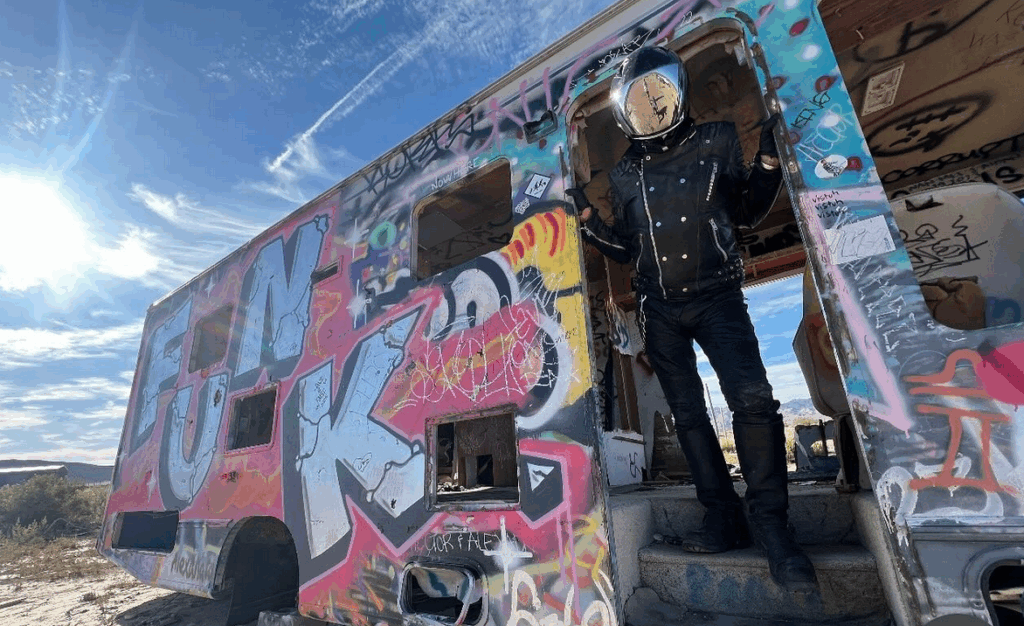
––Talking about videos, On a Rocker shows you riding — freedom, speed, nature. But in contrast, Teenage Robots and On use AI-generated imagery. You’ve said before that you’re uneasy about AI, so why use it?
Daniel Ash: Well, if you can’t beat ’em, join ’em. AI’s here to stay — whether we like it or not. And practically speaking, we just didn’t want to do the old-school thing of standing in front of cameras miming bass, drums, and guitar. I’ve done that for forty years, enough is enough. So, we tried something new. We downloaded this app called AI Pro, had absolutely no idea how to use it, and learned as we went. Our poor video guy nearly lost his mind in the process. But once we got the hang of it, it became fascinating. AI could create visual metaphors we’d never have the time, budget, or technology to film ourselves. Also, thematically, it fit Teenage Robots perfectly. That song is about artificial everything: fake connection, fake emotion. The video had to feel a bit artificial too, almost unsettling in its perfection. Then we got hooked on the idea and used it again for On. There’s definitely a backlash. I saw people shouting “AI is killing art!” But to me, it’s the same story every time something new comes along. When Pro Tools appeared, everyone said it wasn’t real music. When streaming arrived, everyone said it would destroy albums. Now they’re both part of the landscape. The key, for me, is intention. If you use AI to replace creativity, it’s hollow. But if you use it to expand creativity — to stretch imagination — it can be inspiring. You just have to stay human inside it.
––Like CDs before, and streaming more recently, the whole landscape keeps changing.
Daniel Ash: Yes, exactly. It all really started with Napster, about twenty-five years ago. Overnight, music became free. People could download everything, and suddenly bands were earning nothing. Some even split up because of it. Streaming basically grew out of that chaos. Now, musicians still get ripped off on a per-stream basis — it’s ridiculous, the amount of plays you need to make any money — but at least it’s something. Thank God it exists, otherwise we’d get nothing at all. It’s gotten better, though. These days, over 50% of income comes from streaming. Then about 10% from vinyl, a bit from CDs, even cassettes are back in a niche way, but the real money is touring. Always has been, really. And if you’re lucky enough to get a placement, film, TV, commercial, that can be proper income too.
––If touring’s where most of it comes from, do you see yourself touring this album worldwide?
Daniel Ash: It depends. If it catches fire, if the streams, the vinyl, the CDs start to build momentum, then yeah, we’ll look at doing shows. But if it doesn’t, there’s no point forcing it. The album officially drops on October 31, so we’ll give it time to breathe, let people discover it naturally. You can always nudge folks a little after release — sometimes it just takes one person to see the potential and everything starts rolling. Any help spreading the word is always appreciated (pauses)… Wait… Did you hear that?
––Nope. Hear what?
Daniel Ash: Seriously? That was probably a rocket launch. Elon Musk’s satellites go off about fifty miles from here. Every few weeks you’ll hear this huge boom across L.A. and for a second you think, “Is that a bomb?” Then you remember — no, it’s just Elon (laughs).
––I didn’t hear anything…
Daniel Ash: What was I saying? Oh yeah — maybe touring the album. Well, I’d love to. But it all depends on how the record’s received, so we’ll see how things unfold after release day. Any help getting the word out really matters. So, if you like the album, share it, talk about it. That’s how these things start.
––Well, let’s end this interview with a bang then (laughs). I really hope to see you on tour with Ashes and Diamonds. And, congratulations on the release of Are Forever (Oct. 31st). That’s a great album.
Daniel Ash: Perfect ending, isn’t it (laughs)? Well, thank you, it’s always such a pleasure talking with you. And thanks for your support. I hope people love the album as much as you did. And, I’m looking forward to reading your full review of the album.
⩺ FULL REVIEW | HERE
__________________
Mandah FRÉNOT
(c) VMJ
Daniel Ash
⩺ OFFICIAL FACEBOOK | HERE
⩺ OFFICIAL INSTAGRAM | HERE
⩺ OFFICIAL X (ex-TWITTER) | HERE
Ashes and Diamonds
⩺ OFFICIAL WEBSITE | HERE
⩺ OFFICIAL FACEBOOK | HERE
⩺ OFFICIAL INSTAGRAM | HERE
⩺ OFFICIAL X (ex-TWITTER) | HERE
⩺ OFFICIAL YOUTUBE | HERE