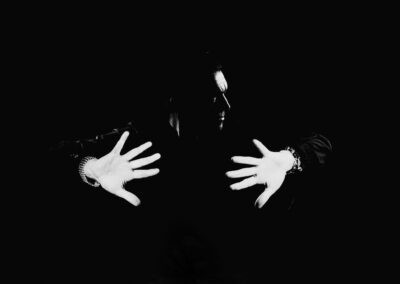
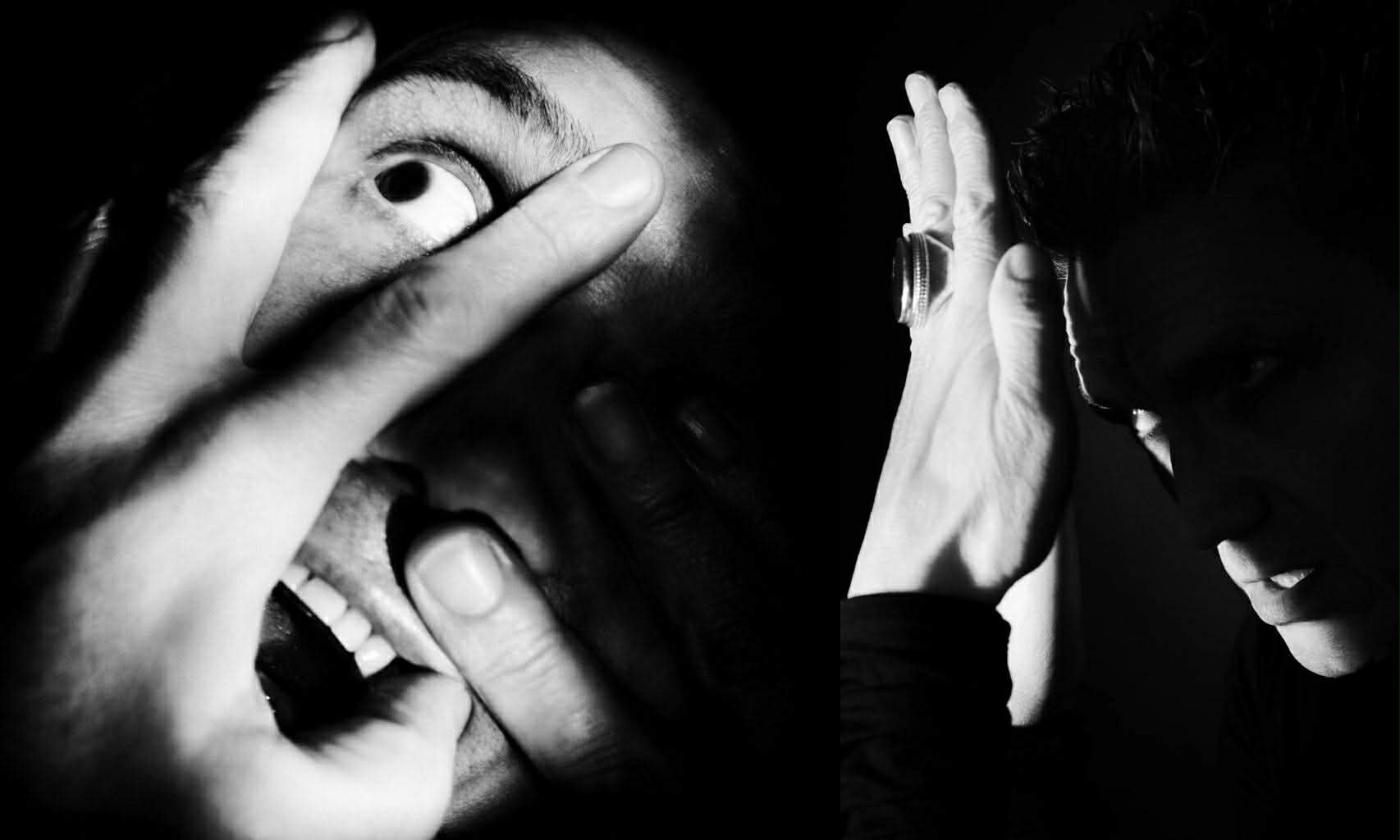
Japan feels like where everything began. Emotionally, it’s very important to me. It feels like a full circle — returning to where it all began. […] Japan represents my formative years — the beginning of my identity as an artist and a network of meaningful human bonds. — Raymond Watts (PIG)
For Raymond Watts (PIG), Japan isn’t a tour stop — it’s an origin story. It was where a nineteen-year-old Watts first landed in 1981, before the decadent weight of the nineties, before the decade that nearly consumed him. Tokyo was the city that laid the first foundations: artistic instincts, human connections, and a sense of direction that would quietly shape everything that followed. Decades later, that bond remains a constant — anchored by lifelong friendships and formative encounters, including a brotherhood with Motokatsu Miyagami (Mad Capsule Markets) that is about to pick up exactly where it left off, when PIG returns to Tokyo in June 2026.
But Japan also carries grief. The most devastating thread running through this conversation is the story of a reunion that almost happened — Watts and his beloved friend Atsushi Sakurai (BUCK-TICK) sitting together in 2023, the same spark, the same weird ideas, the same natural electricity, and a shared plan to finally take SCHWEIN to the world. Then, suddenly, the door closed. That unfinished chapter haunts the edges of everything here, and in many ways, it haunts the album too.
With the release of Hurt People Hurt on May 22nd, Watts isn’t simply returning to Tokyo — he’s returning to the soil where it all began. But the man arriving this June is a fundamentally different beast. The fiercely guarded, solitary process that once defined PIG has thawed. A decade of sobriety has done more than clear the mix; it has dismantled the walls. Where addiction isolates, connection heals — and that shift is audible. Jim Davies, now a full creative partner, is part of it. So is the ease with which Watts now moves through the world: sharing stages, opening up, turning to someone beside him and saying, look at that, isn’t it amazing?
The new album takes its title from a phrase that works as both diagnosis and trap: hurt people hurt. It’s a cycle — damaged people damaging others — but also a blunt invitation into the darkness. Pain, for Watts, has always been a strong thread connecting people. But what’s changed is how he reaches and processes it. Where he once needed chemical chaos to get there, smashing himself against a brick wall just to break through, he now approaches it with the freedom of a child at play — sober, deliberate but no less fearless.
While the signature grit remains, Hurt People Hurt trades blunt-force trauma for something richer and more soulful, a melodic complexity that feels earned rather than constructed. Where he once scribbled lyrics in a drunken haze, words now come first, taking up the most space in his head, mapping the thin line between a kiss and a stabbing, between the sacred choir and the abrasive roar underneath it.
In this conversation, we sit down to talk about all of it — his deep bond with Japan, the theatre of the sacred and the profane, the art and music that make his body vibrate, the friendships, the loss, the self-destruction, and how a life once defined by isolation has finally, genuinely, found its strength in connection.
(c) E. Gabriel Edvy
——Hi Raymond, it’s good to see you.
Raymond: Hi Mandah, good to see you too. How have you been? And what’s it like in Tokyo/Yokohama now — is it spring yet?
——Yes, the cherry blossoms have just started blooming and it’s getting warmer. Spring is just around the corner. What is it like in London right now?
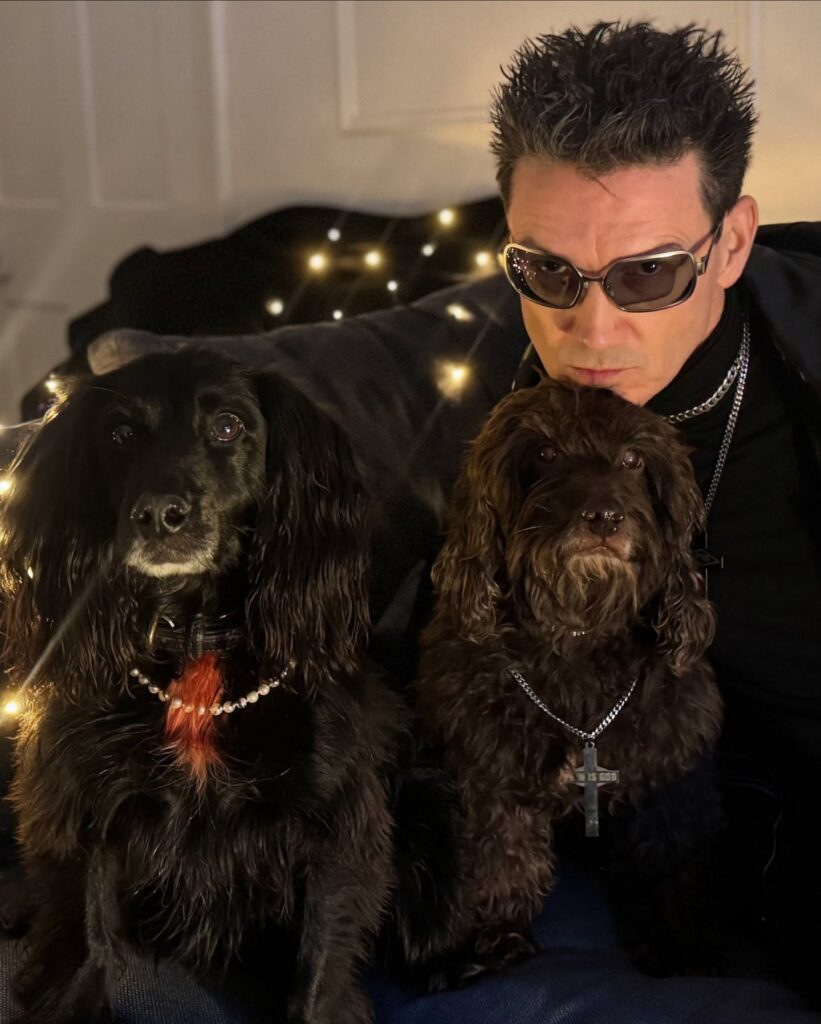
Raymond: That’s wonderful. Well, first I’ve just got to introduce you to someone — this is my dog, Wally. He just snuck up on me (laughs). Say “hi to Wally”. And now, say “bye to Wally”. Off you go Wally… Go! Sorry about that (laughs). Anyway, it’s actually quite similar here — spring is in the air as well, which is pretty fucking nice (smiles).
——Your new album, Hurt People Hurt will be out on May 22nd, so I imagine things must be quite busy at the moment. Thank you, as always, for making time for me. I really appreciate it.
Raymond: It’s a pleasure, and I appreciate being on your radar. You are right, things have suddenly become quite busy. Ideally, I’d spend all my time just making noise, writing, and creating; that’s the part I love. But being a musician also comes with a lot of practical responsibilities — visas, logistics and all the administrative work. The reality of being an independent artist is that you have more control, but also fewer people to delegate to. In the past, there were teams handling certain tasks for me, which made things easier, but it also created some distance from the process. Now it’s much more hands-on. In the UK, we call this kind of setup a cottage industry — a small, self-contained operation. It’s more demanding, but it also feels more direct and real. So yes, everything’s good — just very busy, balancing recording with preparing this release.
——I thought the album had already been completed. Did I listen to the final version?
Raymond: Yes, you did. That one, Hurt People Hurt, is finished and coming out on May 22nd. But there’s always something else in progress. I’m constantly working on new music. In fact, I’ve already started on the next body of work. I am always writing, composing, working onto something. Always!
——Oh, wow! It never really stops (laughs).
Well, for today, I’d like to begin by talking about your return to Japan, and then move on to the new album.
Raymond: Sounds good. Let’s dive in (smiles).
——PIG will play in Tokyo this June, which feels a bit unexpected given the distance from the UK and the stronger industrial scene in Europe. It really shows your willingness to come to Japan. What does Japan represent to you emotionally today?
Raymond: Well, I have a long history with Japan. The first time I came to Tokyo was in 1981 — I was 19. I spent about four or five months there over the summer with a small pop band called CLONES. Nothing major happened at the time, but we played a lot of small shows, met people, and formed connections that lasted a lifetime. In fact, the person who later managed PIG in the ’90s and still does at times today is someone I met during that first trip. Since then, I’ve returned many times, especially throughout the ’90s, working with different bands and projects, including SCHAFT and later SCHWEIN. So, for me, Japan feels like where everything began. Emotionally, it’s very important to me. It feels like a full circle — returning to where it all began. If I had to sum it up, I’d say Japan represents my formative years — the beginning of my identity as an artist and a network of meaningful human bonds. As for the idea of an industrial scene being smaller here, that doesn’t really affect me. I’ve never really thought of PIG as strictly industrial. It’s more like electronic rock, something more fluid, more experimental.
——Sorry for putting that label, I don’t see PIG as just industrial either. What you do goes beyond that. As you said, your relationship with Japan goes back decades, from early PIG releases to projects like SCHAFT and SCHWEIN. SCHWEIN, in particular, felt like a very unique project — bringing together Western and Japanese artists, with two vocalists. The whole thing felt special. What did you take away from it? In what way was it special to you?
Raymond: No problem at all about the label. As for SCHWEIN; well, my history with my dear friend Atsushi began around 1993, I think. We didn’t start collaborating officially until a bit later — maybe around 2000, but from the moment we met, there was just something there. It was a strange, beautiful, and entirely natural connection. It’s hard to put into words even now, but it felt so sincere. There was no pretense, just a genuine resonance between us, both as musicians and as men. I loved him dearly. He was an incredibly supportive friend, and beyond his immense talent as a vocalist, which was truly world-class, we just clicked. We’d spend hours together, not always working, but just being. The idea to form a band together came to me almost as an afterthought of our friendship; when I asked him, he was so keen, and then Imai joined, and the pieces just fell into place. You called it unique, and looking back, I suppose it was. But at the time, it didn’t feel like work or a project. It felt like the most natural extension of our bond. We had ideas, we made noise, we shared stages. It all flowed with this organic ease. Now, with the benefit of hindsight, I realize the music was almost secondary. What really stays with you isn’t the records or the tours; it’s that deep, human connection. That’s the part that never fades. That’s what I carry with me.
——But in a way, his passing makes what you created together feel even more sacred now. I’ve always wondered, though, why didn’t you explore the European or US markets at the time? SCHWEIN felt like it was built for a global stage.
Raymond: Well, that was exactly the intention. We had every plan to take it further, but then life and the industry intervened. There were so many moving parts: contracts, conflicting schedules, and the usual “men in suits” (laughs). When you’re dealing with artists of that stature, the logistics become a mountain. At the time, I was also deep in the trenches with KMFDM in the States, so my own bandwidth was stretched thin. Ultimately, a cocktail of bad timing, label politics, and a bit of hesitation around certain associations just stalled the engine. The real heartbreak, though, is that we actually sat down in 2023, when I was on vacation here, to talk about bringing it all back to life. When we met, it was like the decades between us just evaporated. The same spark was there—the same weird ideas, the same excitement, the same natural connection. We were ready. But somehow, we kept dancing around the calendar, waiting for the perfect moment that never came. And then suddenly, Atsushi was gone. Life made it impossible. It’s a profound regret of mine, that we never got to complete that circle. We both knew there was so much more left to say, so much further we could have pushed it. Now, that door is closed, and I’m left holding the pieces of a story we never got to finish.
(c) E. Gabriel Edvy
——I really wish things had aligned differently for you. I truly do.
You performed quite a few shows together, but there’s very little official footage available?
Raymond: I’m sure the recordings exist. There was always a crew filming, and I probably have some of that footage tucked away in a box somewhere myself. But as far as a proper, official release? No, nothing was ever formally put out. Once again, I think it came down to the powers-that-be. Management decisions at the time were complicated, I guess. Instead of seeing the footage as something to celebrate and push forward, it was treated as something that might muddy the waters or complicate other contractual obligations. Maybe… I’m not sure. It’s a shame, though. There was so much energy in those performances, but it remained caught in that web of industry politics.
——As for your upcoming show, another Japanese friend of yours, Miyagami Motokatsu (Mad Capsule Markets) will join you on stage. When I interviewed him last September, he told me that working with you was one of the highlights of his career. How does it feel to share the stage with him again after all these years? I believe the last time was with SCHAFT.
Raymond: Yes (his face lights up instantly), 1994 (smiles). That’s the last time we played together. And honestly, hearing that means a lot to me. It truly does (he pauses, visibly moved, and rests a hand over his heart). Thank you for telling me about it once again. Aside from being an absolutely phenomenal drummer and I think that goes without saying, everyone knows he’s at the very top, he’s also just a wonderful human being. He’s kind, he’s warm, he’s easy to be around. Motokatsu is just a genuinely good person at heart. I’m really, really happy to be sharing the stage with him again. I’m genuinely excited about it.
Even though language has always been a bit of a barrier between us, it never really mattered. We don’t need to talk that much — there’s just a natural understanding. We get along naturally. I remember when we were hanging out in Tokyo, he brought a friend along to help translate, but honestly, we didn’t need much of it. I’m a little bit taller than him (he leans forward, laughing) but he’s lean and athletic. I remember holding my hand up, way up here, above my head and he was just standing there in front of me. Suddenly, he just launched into the air and kicked my hand! (He mimes the height with wide eyes) I was just… wow. It was incredible. Such agility, such precision. He’s always taken such good care of himself. He’s in amazing shape. I can’t wait to get back out there with him.
——You look quite fit yourself. Do you train as well?
Raymond (laughs): No, not at all. I don’t exercise, or at least not properly (laughs). When I got clean about ten years ago, I did give it a real go for a while. I started running with my dog, but that didn’t last very long. I quickly realized that walking was more my speed, and playing fetch was a much better exercise for me (laughs). The dog I showed you earlier, Wally, is actually the son of my previous dog, Eddie. Eddie passed away about a month ago, which was incredibly hard; it left a big hole in my heart because he was such a special, beautiful dog. But now, I have Wally and he is completely bonkers (laughs)!
——I’m truly sorry for your loss. Pets really are family—they’re the heartbeat of a home. I hope Wally brings you many beautiful new memories to help fill that space. You’ve navigated the Japanese music scene for decades. In those collaborations, did you ever find yourself challenged by a culture or a workflow that felt fundamentally different from what you were used to in Europe or the States?
Raymond (nods thoughtfully): You know, the cultural shift wasn’t really about the music itself, it was the environment surrounding the creation. Creatively, I’ve been incredibly fortunate; whether I’m in Tokyo, London, or Berlin, I’ve always had total sovereignty. No label has ever tried to steer my ship or tell me what I should sound like. But the physical setup in Japan? That was a revelation. Back in the day, when we were in those massive, high-end studios, the room wouldn’t just be the band and an engineer. There would be a whole row of people from the record company — staff, executives, assistants and so on and son — just there. They’d sit in the back, observing every rehearsal, taking meticulous notes on every take. It was a strange sensation. They never interfered but their presence was constant. In the West, the studio is a private sanctuary; you lock the door and only let the inner circle in. Having a silent audience while you’re still finding the song felt unusual at first. It changed the air in the room. That said, once you got past the gallery of observers and focused on the artists themselves, the connection was as raw and natural as anywhere else. With Atsushi, it was refreshingly stripped-back. We didn’t need to be polite or dance around things. It was direct, honest, and purely instinctive: “That’s great, that’s rubbish, let’s try this.” That’s the beauty of it, once the red light is on, the cultural barriers just vanish.
——I see. It sounds like a massive shift in dynamic.
Raymond: It really was. For a long time, especially in the early ’90s, I was a total lone wolf in the studio. It was basically just me, buried in the gear, doing everything myself. I was very protective, probably too controlling, honestly. But over the years, I’ve evolved. My time working in Japan taught me the value of stepping back and trusting the people around me. It was a massive, positive shift in my DNA as an artist. Now, a huge part of that evolution is Jim Davies. What started as a simple remix evolved into something much deeper — guitars, co-writing, and now he’s essentially my full creative partner on this album. What makes it work so well is the lack of ego. Everything stays completely open; if a riff or an idea doesn’t click, we just kill it and move on. There’s zero pressure to “save” something that isn’t working. Having that kind of shorthand with someone is rare, and I’m thrilled he’ll be right there on stage with me in Japan.
——So, PIG has truly evolved from a solo mission into something far more collaborative.
Raymond: Exactly! And honestly, it’s just more fun this way. I know some fans are deeply protective of the ’80s and ’90s material, especially in Europe and the US, but I’ve never been one for nostalgia. I’m always far more electrified by what I’m creating right now. That’s where my heart is.
——I have to agree. I actually find myself gravitating toward your recent albums. They feel richer, there’s more depth, more soul, and a much wider sonic palette.
Raymond: I’m so glad you feel that way (smiles). That’s wonderful to hear. Have you had a chance to dive into the new album yet?
——It landed on my desk a bit late, so I’ve only managed a couple of full spins but I loved what I heard. It feels quintessentially PIG: that marriage of electronics and soul. There are even these moments that feel almost celestial with the choir work. It carries that heavy groove of your recent output, but you can feel the evolution continuing.
Raymond: That genuinely means a lot to me, thank you.
——The title suggests this idea that people who’ve experienced pain often pass that pain on to others. Was there a specific moment or realization that led you to that title?
Raymond: That’s certainly one layer of it, yes. But I wanted there to be others. The phrase “hurt people hurt” is a bit of a linguistic trap. It can mean that the damaged go on to damage others, of course. But you can also read it more simply as “people, hurt, “go ahead and cause pain”. I loved that ambiguity; it’s both a cycle and a statement of fact. Usually, there’s a specific “click” in the process, a phrase appears that feels like a hook you can hang the entire world on. When you’re crafting a collection of songs, they eventually form a body of work, but you still need that one umbrella to bring them all under. For me, the duality of that title captured the complexity I was exploring. On one level, it’s a reflection on how trauma repeats itself. But there’s a darker, more nihilistic undertone there, too—almost an acceptance, or even an invitation into that cycle. It felt like the right “code” for these songs to live in. Once I had that title, everything else just fell into place around it.
——For a long time now, you’ve been creating from a place of sobriety. Do you notice a fundamental difference in the work compared to the days of “chemical help“?
Raymond: I’ll tell you one very simple thing: the mix is better (laughs). When you haven’t slept for three days and your mind is scattered across the ceiling, you just don’t hear well. You make poor decisions. In the nineties, I was consistently pushing the envelope—pushing myself into increasingly extreme psychological and sonic places. I thought I had to keep digging deeper into that darkness to find the music. But I was killing myself. When I finally got sober, I didn’t even know if I’d ever make music again. The breakthrough was returning to the “play” of my twelve-year-old self. Back then, my friend and I would grab a biscuit tin, bash on it, and pretend we were a band. It was pure joy. Somewhere along the way, that got lost. I used to think I had to smash my head against a brick wall at a hundred miles an hour just to get through it. Now, even when the subject matter is serious, I approach it with the freedom of a child playing with ideas. It’s no longer a high-speed collision with a concrete wall; it’s a much more economical, sustainable way to live. There was only so much life left in the smashing.
——Pain remains central to your work. You once famously said, “Pain is God because it’s the thread that connects everyone”. Do you still believe that?
Raymond: Hum… I do, though I’d expand on it now. Pain is a fundamental thread, but so are hope and joy. But, suffering is maybe the most universal experience we have. It’s unavoidable, it’s part of the contract of being alive. The key isn’t the pain itself, but how we process it, whether we can transform that hurt into something constructive. Pain can be overwhelming, yes, but it’s also galvanizing. It shouldn’t be denied; it has to be lived through. Doing so deepens your appreciation for what is truly precious.
(c) E. Gabriel Edvy
——Has your relationship to pain changed after getting sober too?
Raymond: Definitely. I see it as more transient now. I actually just had some dental work done, look at my face, it’s still swollen (laughs)! It reminded me of having a wisdom tooth pulled in Berlin back in ’85. Back then, my solution was to lie in bed with a bottle of brandy and whatever else I could find. I’ll admit, I’m still a bit of a coward with physical pain. My threshold is low and I complain a lot! But the awareness is different. You realize that pain passes, or at least, you hope it does; and that perspective changes how you endure it.
——And emotional pain?
Raymond: Oh, that one is constant! (laughs). That doesn’t go away. But the difference now is that I’m no longer alone in my room, alone with my pain. There’s a saying that the opposite of addiction isn’t sobriety, it’s connection. Addiction isolates you; it locks you in a room where everything feels closed off. Sobriety changed that entirely. Reconnecting with old friends and forming new, deep relationships has been the most meaningful change in my life. You can hear that reflected in how I collaborate now. As I said before, in the early days, I was very protective. I struggled to resonate with others. Even with KMFDM, I often found myself frustrated by other people’s ideas. Meeting Atsushi was the rare exception, an immediate, instinctive connection that I couldn’t explain. But generally, I preferred the solitude. Since getting sober, I find I connect with people so much more easily, both creatively and emotionally. I have a wider circle of collaborators now, and I genuinely cherish that process.
——You’ve described that instant, wordless connection you had with Atsushi. Some believe that’s actually a neurological phenomenon where people who carry the same emotional or psychological wounds “click” immediately. It’s as if your nervous systems recognize a shared history of pain before you even speak.
Raymond: Oh, wow! Yes, probably. That is a fascinating way of putting it. It makes perfect sense that people who carry similar scars, or similar emotional blueprints, would recognize a reflection of themselves in someone else.
——What excites you now, in this new chapter?
Raymond: I think, my focus has shifted from things to experiences. I used to get excited about a new, sparkling guitar, something tangible I could hold. Now, I’m moved by transcendence. I discovered Opera quite late, and the impact has been massive. Occasionally, when the stars align and you’re in the right state of mind, the experience becomes overwhelming. It isn’t just an emotional response; it’s a physical one. My whole body vibrates. It’s like a fizzing sensation deep inside that elevates me. Visual art can occasionally spark that, but opera is on a completely different level. Those moments are extraordinary. I find I’m much more open, much more receptive to that kind of emotional electricity now.
——That actually brings us perfectly to the first single from your new album, Tosca’s Kiss. It’s a direct reference to that world of Opera. What was it about that particular title and that moment in Puccini’s drama that felt right for a PIG song?
Raymond: Exactly, exactly. Well, Tosca is an absolutely brilliant opera — I mean, the tunes are just incredible. It’s almost like a pop structure (A-B-A), but elevated to this epic, difficult scale (laughs). And it features the most cartoon bad guy you can imagine: Scarpia. He puts Tosca in a truly impossible position. He’s an odious, hideous bully, a sexual predator who thinks he’s finally going to have his way with her. She’s trapped between her love for her boyfriend and this monster who’s demanding her body. And in that moment, she says, “So, you want Tosca’s kiss?” Then she pulls out a knife and drives it straight into his heart. It’s such a brilliant, violent metaphor, you simply can’t leave a moment like that on the shelf; you have to pick it up and use it. For me, that “kiss” is a great affirmation. She’s taking the only action she can to avoid being raped, even though it sets off a chain of events that ultimately leads to her own death. The plots in Opera can be complex, but the themes are timeless. Whether it’s Shakespeare or Puccini, it’s the same shit we’re dealing with today. We haven’t fundamentally changed as humans. The emotional resonance of that — the power, the betrayal, the survival — it’s just incredibly strong for me.
——I agree, I agree.
In a song like DNA, you return to that religious imagery and those soaring choir vocals. It creates such a nice contrast with the darker, “sinful” industrial rock. Can you tell me more about that friction? How does Christianity actually fit into your musical identity?
Raymond: Look, people often assume I’m purely anti-Christian, but that’s not true. I was brought up in that environment. So, it’s a lexicon I’m deeply familiar with. I love the architecture of the churches; I love the music. I just don’t subscribe to the ideology. While there are resonant parts of the message that are truly inspiring, so much of it has been lost in translation over the centuries. In this part of the world, Christianity has left some fairly bloody stains across history; it’s a complex legacy. It’s a peaceful religion at its core, but institutions have weaponized it. For me, I just want to use that vernacular—the language of choral music—and collide it with the abrasive elements of electronic industrial rock. PIG has always been a melting pot for those kinds of stylistic crashes. I don’t have any hatred for it, and I’d never sneer at people who find solace or comfort there. I’m just ambivalent. I use the imagery because it’s what I know.
——Would you ever see yourself using the imagery of other religions?
Raymond: Never. I think I’d feel like an imposter. I use the Christian vernacular because I was steeped in it. At school, we had services every single day; I am completely soaked in the sermons, the language, and the spiritual motifs. Even though I rejected it thoroughly, it’s still the soil I grew up in.
——Well, I suppose it’s just part of your DNA.
Raymond (burst into laughter): Good one! Exactly.
——Were there any songs on the album that were especially challenging to write? Or is there a track that feels particularly personal to you?
Raymond: All of them, really. All of them. But what about you, which one is your favorite so far?
——I haven’t had the chance to live with it for long, but I really liked DNA and Scars.
Raymond: Interesting! I’m quite fond of that one myself at the moment. Currently, though, I’m really leaning toward Monkey See, Monkey Do. Did they send you the lyrics with the audio?
——No, I was sent the music only.
Raymond: Oh, shit! Are you kiddin’ me? They should have sent the lyrics. Really! That’s half the story, man! To me, the lyrics are the most important bit. It’s interesting; back in the eighties and nineties, even on The Swining, I was already layering those big gospel and choral vocals. But the way I wrote back then was so different. Music always came first, and I’d just scribble down words while I was drunk in the studio. It was very carefree. Now, the words often come first. They take up so much more space in my head. I’m not saying they’re my favorite part, but the process has fundamentally changed. I might not be writing music every day, but I’m always writing words, even if it’s just reams and reams of absolute rubbish.
——What’s the core of Monkey See, Monkey Do?
Raymond: It’s a simple idea, really. We’re all familiar with the expression, if you show someone something, they’ll repeat it. It’s about the lessons we learn and repeat without ever stopping to ask if they’re the right course of action. We just do it because we were taught to.
——Do you have an example of that in mind?
Raymond: Well, you only have to look around at what’s going on in the world right now. I don’t want to start pointing fingers, but it’s quite apparent that we, as a species, repeat certain patterns of behavior. We should be a lot more thoughtful about the cycles we’re trapped in, but instead, we just repeat.
(c) CREATIVE MAN
——You’ve said before that London is your base, where daily life happens, so you sometimes need to leave in order to feel creatively recharged. You told me last year you visited Poland. You described Auschwitz-Birkenau as mind-numbing. How did that experience echo on Hurt People Hurt?
Raymond: Ooh, fuck me… wow! First of all, you have a phenomenal memory. Second, that is a very, very difficult question. Visiting the scene of one of the greatest crimes in history is extraordinary and vital, but the scale of it is almost impossible to truly take in. I can’t say exactly how it influenced this album. My process is much more automatic than that. I let the words come out, and I edit them later, but I try not to look directly at where they’re coming from while I’m writing, I’m afraid I’ll frighten the inspiration away if I stare at it too hard. People often ask me, “What does this mean?” or “Where did that line come from?” but the truth is often a mystery to me, too. Sometimes the real message doesn’t reveal itself until months or even years later. I might look back in a decade and finally understand how Poland landed on this record, but right now? I can’t tell you. There is a deep, subconscious element to the work that I have to protect, even while I’m being meticulous about the scanning and the language.
——It sounds like the travel itself is as much about the mystery as the destination.
Raymond: Yeah, exactly. Poland was fucking cold, it was minus something but Krakow is such an incredibly beautiful city. As I get older, the more I see of Europe, the more I realize how little I’ve actually seen. I’ve traveled quite a lot, but there’s so much more I want to experience. It’s the same with the music. I’ve just finished this album, but we’ve already started on the next body of work. It’s a constant cycle: the more you do, the more you want to do. The more you travel, the more you want to see. There isn’t enough time in a life to fit it all in (sighs).
——When you travel, whether it’s the South of France, Japan, or Poland, the atmosphere is always so distinct. Do you choose where to go based on a feeling you’re looking for beforehand, or is it more spontaneous, like going somewhere first and then discovering whatever inspiration comes from it?
Raymond: It’s a bit of both. I’m pretty relaxed; I can slum it in a dive or stay in a smart hotel, I just love the act of traveling, especially by train. I’ve always been incredibly fond of Southwest France and had a little house there for a while. I actually just got back a few weeks ago; it rained the entire bloody time, but we just sat around and ate like kings. It’s a beautiful way to live. But there is still so much I want to see. I’m dying to explore the Japanese countryside more. I had such a heavenly time about three years ago staying down by Mount Fuji in Gotemba. Sitting in an onsen with that incredible view of the mountain, it was unbelievable. It reminded me of 1981, staying in an old-style wooden house right at the base of Fuji for ten days. Absolutely heavenly. I’d love to really head into the interior of Japan next. Do you get to travel domestically much yourself?
——Unfortunately, no ! But I wish I could.
By the way, in our 2023 interview, I remember asking you if you were a polyglot because you’ve recorded in different languages, including Japanese. You didn’t think you had, and I couldn’t remember the song title at the time—but I checked! The song was Cry Baby. Do you remember recording those Japanese parts?
Raymond: Oh (laughs)! No, that wasn’t me. That was my then-girlfriend, Anna. We lived together in Berlin in the eighties and worked on a project called Sow. We did three albums together before splitting up around ’96. For Cry Baby, a friend of mine who was married to a Japanese woman came into the studio to help her with the phonetics. It was a painstaking process — line by line, describing exactly how to pronounce everything. But, I don’t speak anything but English. I can mumble a little German, but that’s about it. I love how German sounds. My French is absolutely, unbelievably bad, a total horror show. Back in the day, I’d get drunk and think I could speak it, but it was a complete train wreck. Don’t even think about making me try now! (laughs).
——I won’t (laughs).
You’ve mentioned that travel feels different for you now. Is it the sobriety, or just a change in how you want to experience the world?
Raymond: In the ’90s, I’d be on a massive tour bus, isolated in the back, never even looking out the window. I wasn’t connecting with anyone, and travel brought me no joy. Now, touring in vans and staying in motels feels more real. I’ve realized that for me, travel is only meaningful if it’s shared. Standing at the top of a hill with a beautiful view is fine, but being able to turn to someone and say, Look at that, isn’t it amazing? That amplifies everything. I’ve also developed this hypnotic love for driving across America. In the UK, I’m bored after thirty minutes, but in the States, I can sit there for eleven hours in a trance, just watching the landscape unfold. I don’t even need music; I just take it all in.
——I know that feeling (smiles).
You’ve often used wordplay and humor, once saying your lyrics lean toward satire over sarcasm—that satire exposes truth rather than simply mocking. What “uncomfortable truth” were you digging for with Hurt People Hurt?
Raymond: I’ve never been a fan of sarcasm; it’s the lowest form of wit — unless, of course, I’m directing it at myself! Then it’s perfectly acceptable. With my writing, I’m not interested in spraying a message on a wall or preaching a sermon. I’m just trying to open a door to find my own truth. But that’s the trick, isn’t it? Every time you manage to kick a door open, you don’t find a tidy answer waiting for you, you just find another fucking question. With Hurt People Hurt, the truth I was circling is right there in the title. It’s that uncomfortable, jagged cycle of human behavior. We’re all carrying these inherited wounds, these patterns we repeat without even thinking — that “monkey see, monkey do” element of the soul. I wanted to explore the idea that the damage we do to others is almost always an echo of the damage done to us. There is no absolute, shimmering truth I’m trying to hand the listener. My only goal is to keep opening those doors, even if what’s behind them is dark or difficult. I’m looking for the resonance in the struggle. I think if you can find the humor in the horror, the satire in the suffering, you’re getting a lot closer to the reality of being alive than any “pure” truth could ever give you.
——Do you feel the humor surrounding PIG is rooted in your British DNA? How would you describe that specific brand of wit?
Raymond: It’s almost certainly down to a very British sense of dry humor, something I’ve only recently started to truly appreciate. For years, I had this desperate urge to be anywhere but here; I even escaped to West Berlin for five years just to get away. But there’s a lot of truth in the saying that the best part of travel is the homecoming. I see London with much richer eyes now. There’s a unique, understated irony in English humor that is quite rare elsewhere. We have some marvelous exponents of that “deadpan” style here, and it definitely bleeds into the way I write.
——You mentioned wanting to escape. What was it about London that felt so unbearable back then?
Raymond: It was a completely different world. In the late seventies, during the height of punk, I was living in squats and the atmosphere was incredibly tribal—and very violent. It felt like being “hunted.” If you ran into a group of rockers, they’d beat you up for being a punk. If the skinheads saw you, they’d do the same. Even the New Romantics, with all their makeup and frills, were getting attacked in the streets. I was young, I was angry, and I was frightened. I didn’t see the beauty of the city because I was too busy looking over my shoulder. I’m older now, and I’ve realized you truly don’t know what you’ve got until it’s gone. I find joy in things today that I was simply too guarded to notice back then.
——I understand that completely. After ten years in Japan, I’ve developed a massive appreciation for the weight of European history and art. It’s breathtaking when you step back. What is it about London that captures you now?
Raymond (nods): Exactly. It’s funny how that works, isn’t it? We only seem to develop that true appreciation when we’re far away — or when we’ve got enough years behind us to actually see it. It’s a perspective that only comes with distance and age. As for me, I’ve come to see London as a fascinating collection of villages, each with its own soul. My girlfriend lives in Ham, near Richmond Park, an area I barely knew before. It’s right by the river, incredibly lush and green, surrounded by these stunning Georgian houses. The park itself was a hunting ground for Henry VIII centuries ago; it’s massive, filled with deer, and offers these sweeping, incredible views of the city. The beauty of London is its diversity of landscapes. If you want those bakingly hip cool vibes, you head to Shoreditch or Old Street. If you want something different, you have Soho or Hampstead. It’s all happening here, and the art scene is world-class. Every two weeks, my friend Mark Walton, a brilliant, fabulous, poet I’ve known for decades and a true art aficionado and I make a point of visiting a gallery or seeing something new. I’ve gone from being a kid hunted in the streets to someone who spends his afternoons seeking out the greatest art the city has to offer.
——Last question, Raymond, we’ve been talking for over an hour and I know your schedule is packed. When the Tokyo shows are over and the house lights finally come up, what do you hope people feel as they walk out into the night?
Raymond: I hope they feel absolutely exhausted. I want them to be hot and sweaty. But more than that, I want them to feel a real sense of spiritual rebirth (bursts into laughter). A PIG show is meant to be a visceral, physical experience, but it’s also a communal one. You’ve just spent an hour and a half in a room with other people, sharing in this loud, chaotic, and beautiful noise. My hope is that the music acts as a sort of exorcism for whatever weight they’ve been carrying. If they can walk out into that Tokyo night feeling a little lighter, cleansed by the sweat and the sound, then I’ve done my job.
——See you in June, then. And a huge congratulations on the release of Hurt People Hurt on May 22nd. It’s another brilliant record, and I’m so glad we got to talk about it today. I had a wonderful time, thank you Raymond.
Raymond: The pleasure has been all mine. It’s been really lovely talking to you, and I’m genuinely looking forward to seeing you in June. Bye-bye! Sayonara! And sorry if I talked too much rubbish (laughs). Have a lovely day, Mandah.
Mandah FRÉNOT
(c) VMJ
─────────────
⩺ OFFICIAL WEBSITE | HERE
⩺ OFFICIAL X | HERE
⩺ OFFICIAL INSTAGRAM | HERE
⩺ OFFICIAL FACEBOOK | HERE
⩺ OFFICIAL YOUTUBE | HERE